 Product News
Vacuum Brazing Tungsten Steel to Mold Steel
Normantherm•6/4/2026
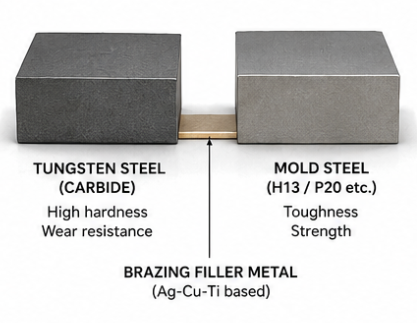
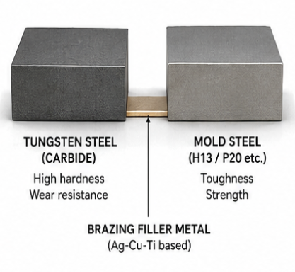
Vacuum brazing is the premier method for bonding tungsten steel (cemented carbide) to mold steel—a combination vital for high-stress cutting tools and progressive dies. The primary challenge is that tungsten steel expands and contracts at less than half the rate of mold steel when heated. Vacuum brazing solves this by heating the components uniformly inside a deep vacuum furnace, preventing the warping, cracking, and severe internal stresses caused by traditional localized welding.
Before entering the furnace, both metals undergo rigorous ultrasonic cleaning to remove surface oxides and oils. A specialized silver- or copper-based filler alloy containing active elements like titanium or cobalt is then placed at the joint. These active elements are crucial because they lower surface tension, allowing the molten filler to chemically wet and bond to the notoriously stubborn tungsten carbide surface.
Inside the furnace, the assembly is slowly heated to an intermediate soaking temperature so both distinct metals reach the same uniform temperature. The heat is then raised just above the filler’s melting point, drawing the liquid alloy deeply into the joint gap via capillary action. A highly controlled, slow cooling phase follows, allowing the metals to contract safely at their different rates without cracking the bond line. This produces a flawless, high-strength atomic joint ready for heavy-impact industrial use.