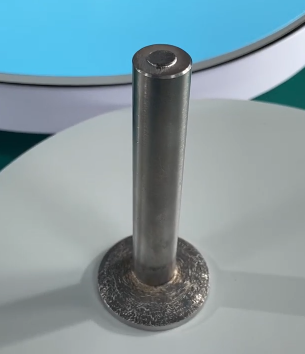
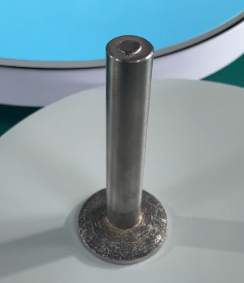
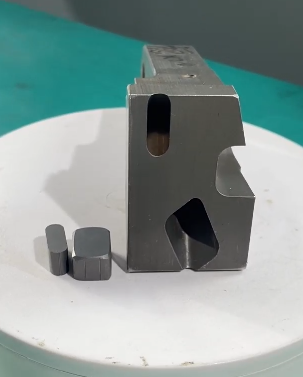
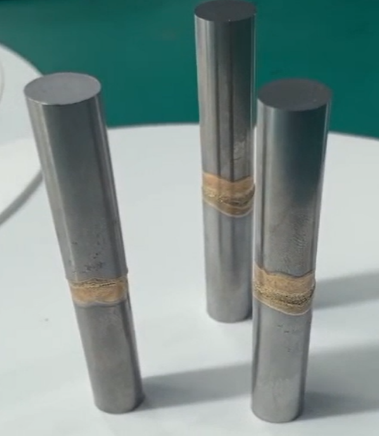
Three materials. One finished product. No compromises.
Tungsten steel delivers extreme hardness and wear resistance for cutting edges and high-wear surfaces. Mold steel provides toughness impact strength and reliable performance under repeated stress. Stainless steel adds corrosion resistance cleanability and structural integrity where exposure matters.
Welding these three dissimilar metals into a single finished product requires real expertise. Each material behaves differently under heat. Each has its own thermal expansion rate and metallurgical characteristics. Get it wrong and the joint becomes a failure point.
Our precision welding process gets it right. Clean controlled conditions ensure strong bonds between each material interface. The result is a finished product where every section does its job without weakness at the transitions.
These multi-material components deliver superior strength across the entire assembly. Wear resistance is excellent where tungsten steel sits. Structural reliability comes from the mold steel core. Corrosion protection is built in where stainless steel faces the environment.
Designed for demanding tooling machining and industrial applications requiring high durability and long service life. When your component needs to cut hard withstand shock and resist corrosion all in one package tungsten steel to mold steel to stainless steel welding delivers.
You may also like
Cemented Carbide Welding with Cr12MoV
Cemented carbide brings extreme hardness and outstanding wear resistance to any cutting edge. Cr12MoV tool steel delivers high compressive strength good toughness and excellent dimensional stability. Weld them together and you get a component that outperforms either material alone.
Tungsten carbide vacuum brazed products are high-performance industrial components designed for applications requiring exceptional hardness, wear resistance, and durability.
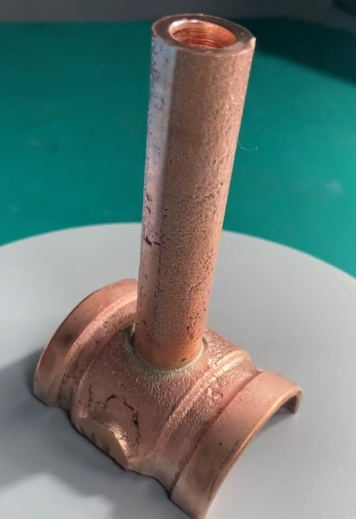
The sample component shown above demonstrates a typical vacuum brazed copper assembly consisting of a tubular section joined to a formed copper base. Such joints demand excellent metallurgical bonding without oxidation, distortion, or contamination.